Governing AI as an Intellectual Commons: A Reparative Political Economy for Shared Intelligence
"The central policy question is not only how to regulate AI, but who it belongs to, who it serves, and who has a right to benefit from it."
Introduction: AI at a Crossroads
Artificial intelligence is rapidly becoming part of the core infrastructure of the global economy, shaping labor markets, public services, scientific research, and knowledge production. Yet its development is proceeding under an old and familiar logic: concentrated ownership of a transformative productive system by a small number of firms that claim proprietary rights over capabilities built from the data, creativity, and labor of billions of people.
At the same time, leading voices in AI governance warn that frontier systems pose real systemic and even catastrophic risks if they remain poorly governed, from destabilizing economic shocks to misuse in high-risk domains. These warnings coexist with enormous promise: AI could expand scientific capacity, improve public services, and reduce drudgery if it is governed in service of broad human flourishing rather than narrow financial return. The central policy question is therefore not only how to regulate AI, but how to decide who it belongs to, who it serves, and who has a right to benefit from it.
This paper argues that AI should be governed as an intellectual commons: a shared human creation grounded in collective data, cultural production, and intergenerational knowledge. On this view, no single firm can claim full moral ownership of AI’s productive capacities, because those capacities arise from widespread human contribution and from infrastructures built over time through public investment, social cooperation, and often extractive appropriation. Treating AI as an intellectual commons does not eliminate a role for markets or private enterprise, but it does require a different legal, financial, and governance architecture—one rooted in stewardship, democratic accountability, and reparative justice.
One useful contemporary reference point for this argument is the growing field of digital public goods, which seeks to build open, reusable digital infrastructure governed for public benefit rather than narrow private extraction. It offers a concrete example of how software can be legally and institutionally structured around stewardship: with openly-licensed code, and non-profit governance models designed to reinvest revenue into the platform and community rather than only maximize returns to shareholders. Although this is not itself the proposed model for governing artificial intelligence, it helps clarify the distinction between proprietary digital systems and public-interest digital infrastructure. That distinction matters for AI because it shows that digital systems need not be organized around enclosure, sale, and data extraction by default.
These developments illustrate both the promise and the limits of current digital public goods discourse. They demonstrate that digital infrastructure can be built as a shared, mission-driven resource for publishing and knowledge circulation, but do not by themselves resolve the deeper questions this paper raises about training data, collective ownership, value distribution, and reparative justice in AI systems. In that sense, the digital public goods model is best understood not as a complete answer to AI governance, but as a partial institutional prototype: a reminder that public-benefit design is possible, and that the next challenge is to extend this logic from software infrastructure to the political economy of AI itself.
"The irony of the intellectual tradition that claims [Adam] Smith as its patron saint is that it has largely inverted his warning."
Beyond the Stationary State: Ownership, Race, and the Bounded Imagination
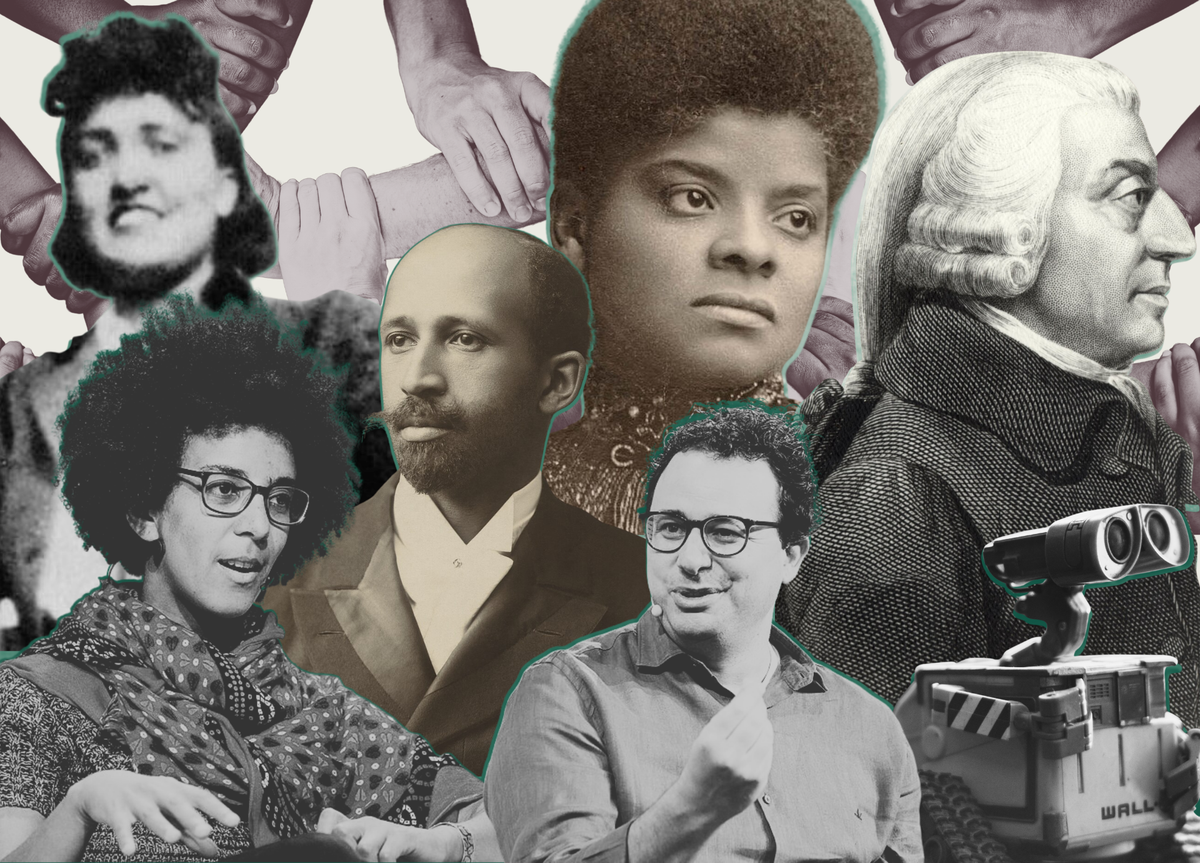
Adam Smith was not an uncritical celebrant of capital accumulation. One of the more searching passages in The Wealth of Nations concerns what Smith called the stationary state — the condition toward which he believed all commercial societies naturally tended as they matured. In that state, wages would fall toward subsistence as competition among laborers intensified; profits would thin as the most productive investments were exhausted; and ownership, already concentrated, would become further entrenched. The economy would not collapse — it would simply stop.
Smith’s concern was structural: namely, that the logic of capital accumulation, left unchecked, would eventually produce a social architecture in which most people had little meaningful stake in the wealth their labor helped generate, and in which the dynamism of commercial life would calcify into stagnation.
The irony of the intellectual tradition that claims Smith as its patron saint is that it has largely inverted his warning. Where Smith feared concentration as a symptom of decline, neo-classical economics came to treat it as a precondition of growth, seeing it as the necessary price of the entrepreneurial energy that drives innovation forward.
What Smith did not fully theorize, and what later political economy has been slow to confront, is that determining who counts as a legitimate claimant to collectively generated wealth has never been purely economic. It has always also been political and racial. Viewed through a racial-capitalism lens—drawing on Cedric J. Robinson and subsequent scholarship—the historical effort to restrict access to common wealth appears inseparable from judgments about race and deservedness.
This is not a claim about any individual’s private motives. It is a structural point: over centuries, the boundaries of legitimate economic return have been drawn and redrawn in ways that systematically excluded the people whose labor and land underwrote American prosperity. As consequential as it has been, the bounded ownership model is not merely the product of an intellectual mistake. It is a political construction—built, defended, and repeatedly adapted to preserve the conditions under which a narrow class of claimants can present its returns as natural rather than socially produced.
Indulge me with a thought experiment to demonstrate and make visible the stakes of that enduring construction.
Imagine that the wealth generated in the original colonies and the early United States had been understood from the outset as co-owned by all who contributed to its production: the indigenous nations whose lands were the precondition of settlement; the enslaved, whose unrecompensed labor undergirded American agricultural and industrial wealth; the women and underpaid workers whose contributions were systematically excluded from formal accounting.
The result would be that the extraordinary concentration of wealth and income that now defines American economic life — the grotesque gap between the very top and everyone else — would not exist in anything like its current form. Those with exceptional skill and ingenuity would still be rewarded. The incentive to create, to build, to organize complex productive activity would still operate.
But no individual would be on a trajectory to become a trillionaire primarily on the basis of knowledge and infrastructure that was itself produced through public investment, collective cultural inheritance, and decades of labor by people whose names will never appear in a shareholder registry.
"It was deliberately engineered to re-trap formerly enslaved people in cycles of debt and dependency before the question of liberated Black labor could produce its own answer."
The Reconstruction era offers more than a thought experiment. It offers a historical test case — a brief, brutally constrained experiment in what happens when people long denied access to their own labor and time are partially freed. The structural, political, and economic organization that produced sharecropping, convict leasing, and the Black Codes was not the spontaneous product of market adjustment. It was deliberately engineered to re-trap formerly enslaved people in cycles of debt and dependency before the question of liberated Black labor could produce its own answer.
Yet even within those harsh constraints, something remarkable happened. The Harlem Renaissance. The birth of jazz and the blues. An outpouring of literary, artistic, and intellectual production of world-historical significance emerged from people who had even partial access to their own time, creativity, and futures. What those decades demonstrated, against every effort to suppress it, is the productive and cultural richness that becomes possible when more people are liberated from drudgery, and when the surplus of human attention and capacity can flow somewhere other than someone else’s ledger.
This is the argument at the heart of the AI commons framework. If artificial intelligence genuinely reduces the demand for routine labor — and the evidence suggests it will — then the decisive question is not whether that productivity gain will exist. It is who will receive it.
In their book, From Here to Equality, William Darity and A. Kirsten Mullen argue that if the returns flow exclusively to the bounded ownership class, they will deepen the oldest patterns of American inequality, extending into the digital age the same structural logic and outcomes that shaped the plantation, the sharecropping contract, and the century of artificially suppressed Black wealth that followed. If instead those returns are understood as a dividend on collectively held intellectual capital: on the data, the cultural production, the scientific knowledge, and the intergenerational human effort that made AI systems possible — then something else becomes conceivable. Something closer to what the development of leisure produced in all societies for those who gained access to it: improvements in art, music, science, civic engagement, and the ordinary texture of daily life that no market mechanism could have planned or predicted.
The Anthropic public benefit corporation model deserves acknowledgment here as a meaningful signal. It suggests that at least some actors within the AI industry understand that the purely extractive model is morally and practically inadequate. Its limit is that it sets an upper bound, not a baseline: it still relies on a bounded ownership structure in which control, decision-making power, and economic gains remain with a defined group of owners, however responsibly they act. The AI commons framework advanced in this essay would not merely adjust that structure; it would replace it.
"AI replicates this injury digitally."
From Henrietta Lacks to AI Extraction
The history of Henrietta Lacks remains one of the clearest moral analogies for the present moment in AI. In 1951, cells taken from Lacks, a Black woman, without her knowledge or consent became the HeLa line, which powered decades of biomedical breakthroughs and commercial use. Her family, meanwhile, received neither meaningful recognition nor a share of the value those cells generated for decades. Recent legal efforts by her descendants have brought renewed attention to the injustice of extracting value from a person’s biological material without consent and without fair participation in the gains.
AI replicates this injury digitally. Large models are trained on text, code, images, voice, social traces, and increasingly on data linked to bodies and behavior, often collected at scale without meaningful consent from or bargaining power for those from whom the value is derived. The economic upside accrues overwhelmingly to developers, cloud providers, and shareholders, while the people and communities whose lived experience and creative output animate the systems remain structurally outside the value chain.
This pattern must also be understood through the lens of racial capitalism. Histories of enslavement, colonization, medical exploitation, discriminatory surveillance, and under-compensated cultural production have repeatedly transformed the lives and bodies of marginalized communities into value for dominant institutions.
The Distributed Artificial Intelligence Research Institute (DAIR) and Ida B. Wells Just Data Lab offer two potent examples of organizations not only addressing this reality, but developing alternatives the world would stand to gain from. The work of both institutions has offered a rigorous foundation for understanding the social harms, potential, and faulty assumptions of current AI development and data-intensive systems. Scholarship on algorithmic reparation has shown that technical fairness frameworks are insufficient because they address symptoms rather than the deeper structures of extraction and exclusion embedded in data systems. The serious policy, creative, and economic response to AI must therefore move beyond bias mitigation and directly confront ownership, compensation, and power.
AI as an Intellectual Commons
The commons tradition offers a richer language for AI governance than the standard debates framed solely around innovation and regulation. Commons governance has historically been used to describe the management of shared resources that are collectively maintained and stewarded under rules designed to preserve access and public benefit. In the digital context, this idea has been extended to open knowledge systems, public data, and digital infrastructures that become more socially valuable when they are not fully enclosed by private ownership.
AI belongs in this conversation because its capacities are generated from shared intellectual capital. Foundation models derive power from the aggregate output of human language, problem-solving, culture, and interaction at scale. Even where firms provide extraordinary engineering, capital, and computing, the underlying corpus of human expression on which it rests remains indispensable. That reality creates a strong normative case that core AI systems, especially those trained on broad public and human-generated data, should be subject to obligations of broad benefit, public accountability, and value-sharing.
This framing helps address and correct two distortions in current policy. First, it challenges the assumption that AI value originates primarily with the firm that assembles a model, rather than with the social field from which the model learns. Second, it shifts the debate from whether the winners of AI growth should later be taxed for redistribution, to whether the gains should be distributed from the beginning as returns on a collectively grounded asset.
"Payments to households... as dividends on co-owned intellectual capital rather than welfare transfers."
From UBI to Co-Ownership
Much current discussion of AI’s economic consequences focuses on labor displacement and the possibility of universal basic income or wage insurance. Those debates, while important, leave intact the baseline assumption that AI firms rightfully own the productivity gains and that society’s only option is to tax a portion of those gains after the fact. This framing is politically vulnerable and morally incomplete.
A commons-based approach offers a different political economy. If AI is built on the contributions of many, then all members of society have a claim not merely to relief from disruption but to a share in AI’s productive capacity and, fundamentally, to co-ownership. Payments to households can therefore be understood as dividends on co-owned intellectual capital rather than as welfare transfers. This distinction matters because it changes both the legitimacy and the political narrative of distribution.
This report, therefore, proposes a two-part structure for distribution:
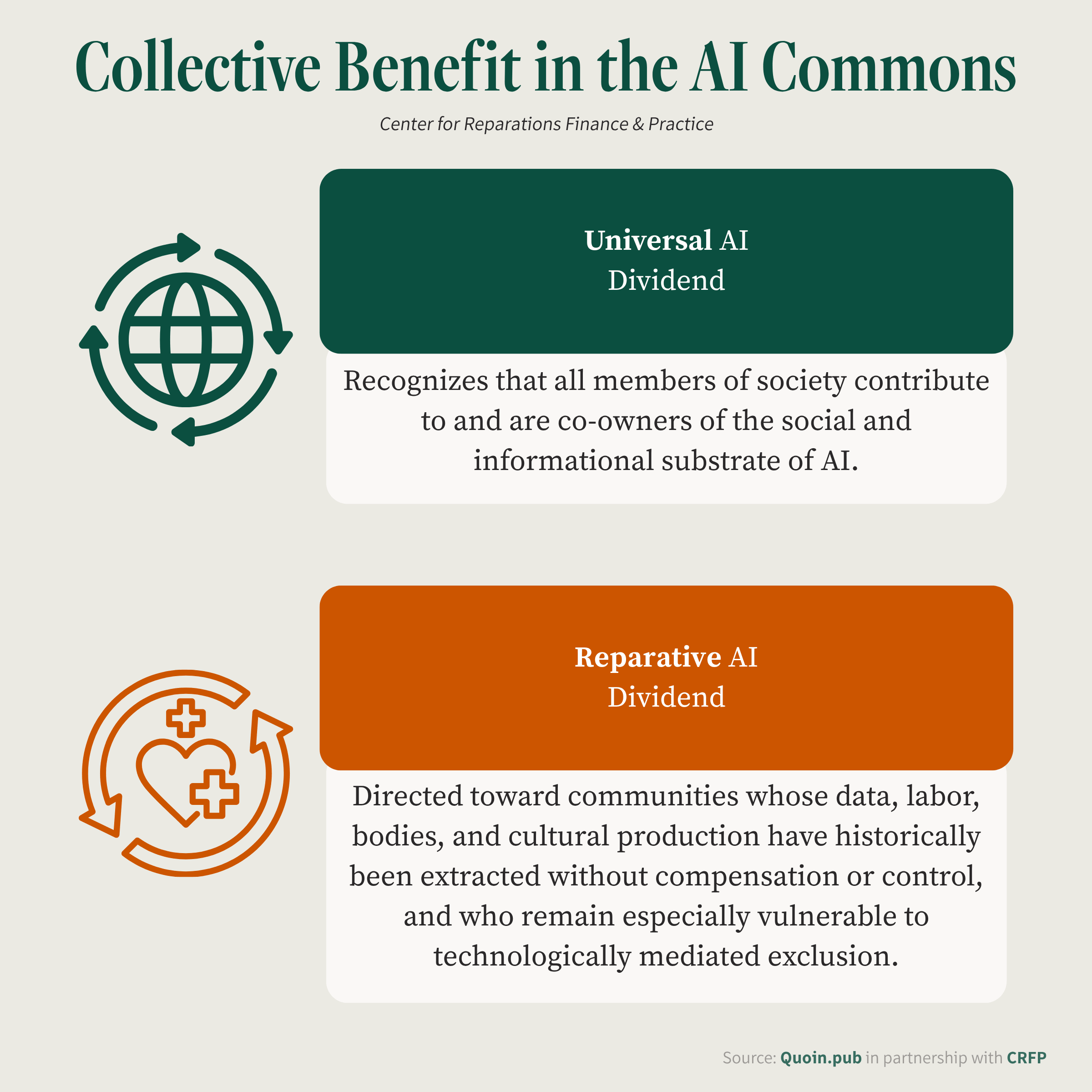
The first is a Universal AI Dividend, paid from a public AI Commons Fund to recognize that all members of society contribute to and are co-owners of the social and informational substrate of AI.
The second is a Reparative AI Dividend, directed toward communities whose data, labor, bodies, and cultural production have historically been extracted without compensation or control, and who remain especially vulnerable to technologically mediated exclusion. This second tier reflects the reality that formal equality alone cannot repair unequal starting positions or inherited harm.
Legal Foundations: Data Dignity and Stewardship
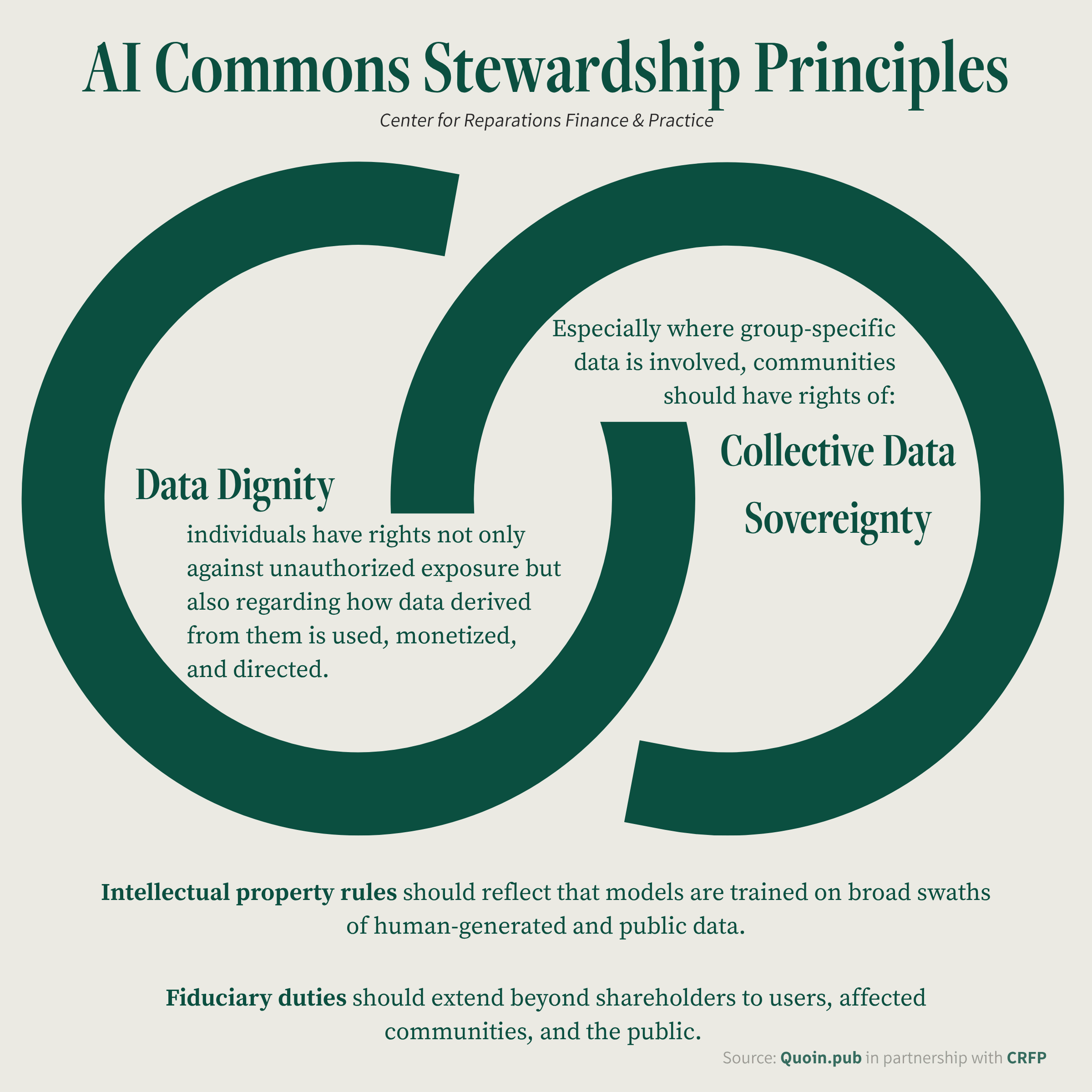
Existing legal frameworks are poorly matched to the realities of AI production. Privacy regimes focus primarily on collection and disclosure, while intellectual property law tends to reward downstream model ownership without adequately recognizing the social character of training data and knowledge production. A more adequate legal architecture should begin from the principle of data dignity. Data dignity means that individuals have rights not only against unauthorized exposure but also regarding how data derived from them is used, monetized, and directed. As co-owners, public governance of AI development and deployment would be a fundamental principle.
Under such a framework, individuals should have the right to know when their data is used to train AI systems, to challenge uses that cause material harm or violate meaningful norms of consent, and to participate in the value those systems produce. Because many harms and forms of appropriation are collective rather than merely individual, communities should also have rights of collective data sovereignty, especially where group-specific cultural, linguistic, racial, or Indigenous data is involved.
Intellectual property rules should also be revised. Models trained on broad swaths of human-generated and public data should not be treated as ordinary proprietary assets with unrestricted exclusion rights. Instead, policymakers should consider a regime of conditional and limited commercialization rights, particularly for foundation models that become systemically important. Such rights would be contingent on transparency, safety practices, licensing obligations for essential uses, and meaningful benefit-sharing.
Finally, major AI firms should bear obligations similar to those imposed on systemically important institutions in other sectors. When companies control foundational systems that influence labor markets, public discourse, and essential services, their fiduciary duties should extend beyond shareholders to users, affected communities, and the public. AI at scale should be governed as a matter of stewardship, not left to private discretion alone.
Institutions for an AI Commons
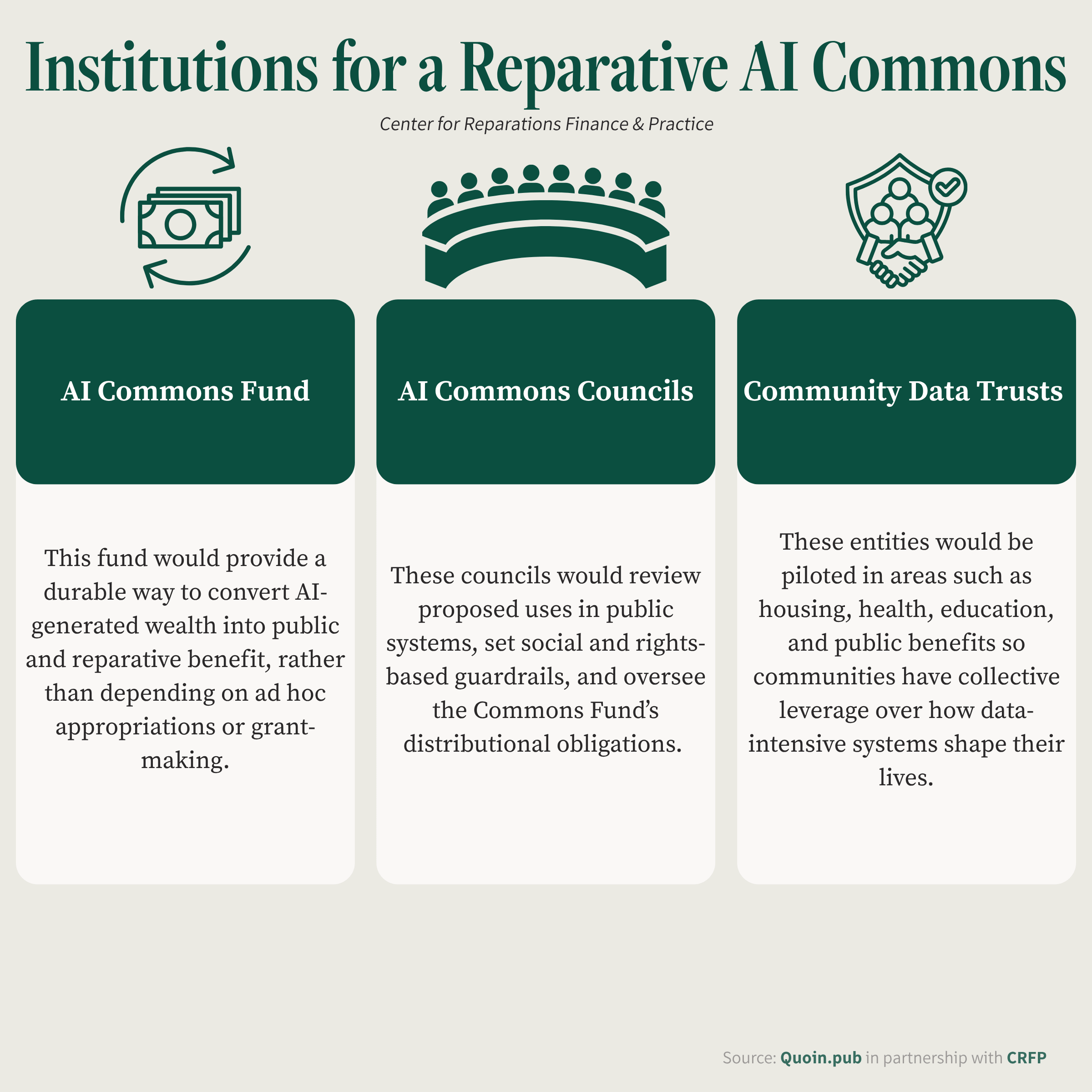
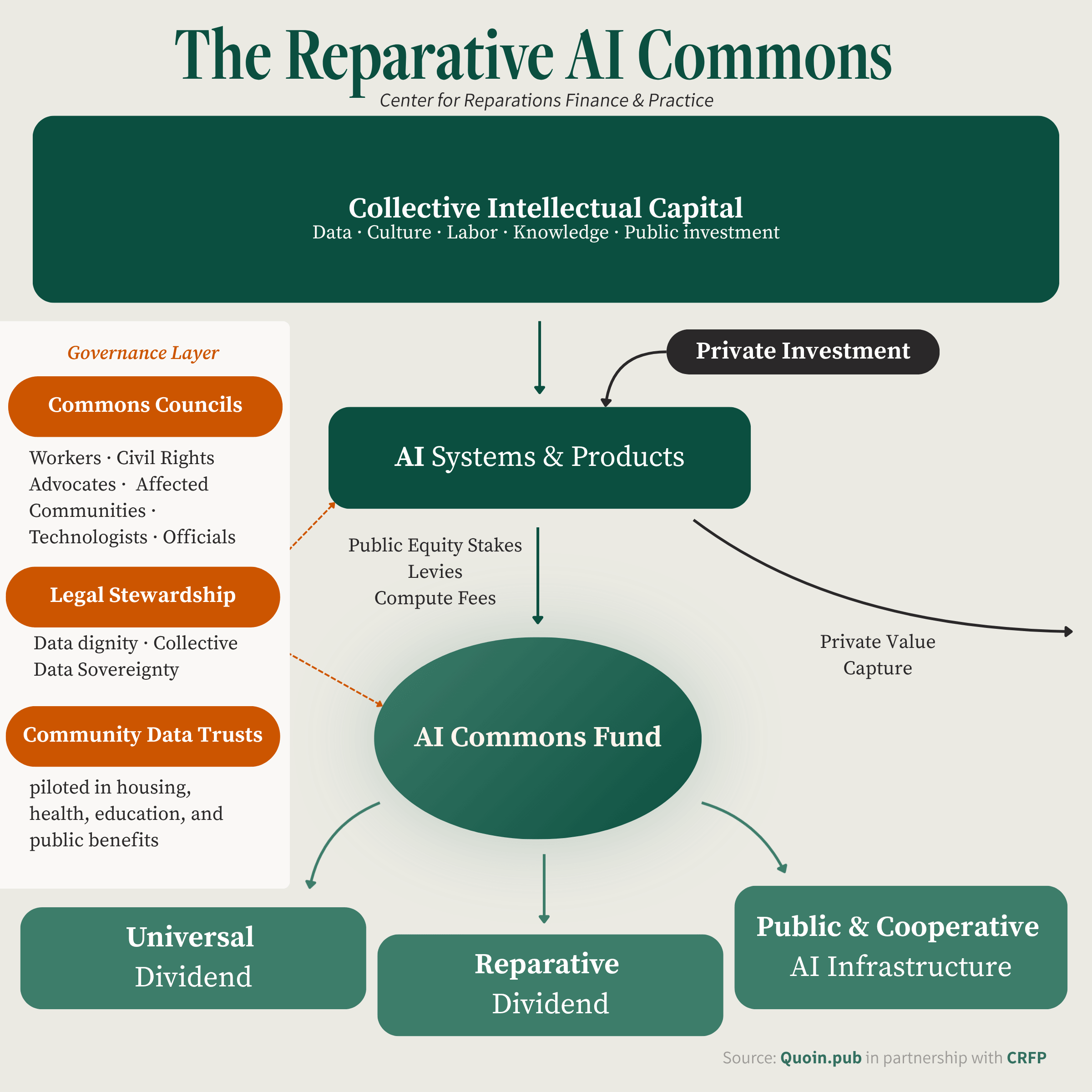
A lasting AI commons requires institutions that can capture, govern, and redistribute the wealth AI creates. The central mechanism should be an AI Commons Fund, financed through several sources: levies on high-revenue AI activity, fees tied to large-scale compute use, public equity stakes when public support has helped drive innovation, and penalties for exploitative or rights-violating practices. This fund would provide a durable way to convert AI-generated wealth into public and reparative benefit, rather than depending on ad hoc appropriations or grant-making.
The fund should serve three core purposes: finance a universal AI dividend; support reparative dividends and targeted investments in communities long subject to extraction and underinvestment; and build public and cooperative AI infrastructure, including open models, public compute resources, and community-based technical institutions that reduce dependence on dominant firms.
Governance should also be shared. National and local AI Commons Councils should include workers, civil-rights advocates, technologists, affected communities, and public officials, with real authority over high-risk deployments and public-interest conditions. These councils would review proposed uses in public systems, set social and rights-based guardrails, and oversee the Commons Fund’s distributional obligations. At the same time, community data trusts should be piloted in areas such as housing, health, education, and public benefits so communities have collective leverage over how data-intensive systems shape their lives.
"The fundamental risk is that DPG standards could normalize 'stewardship without repair.'"
Digital public goods as an institutional bridge
The digital public goods (DPG) framework offers a useful bridge between abstract claims about AI as a commons and concrete institutional design.
The Digital Public Goods Alliance (DPGA) describes itself as “a global community of national governments, multilaterals and international non-and for-profit organisations with a shared commitment to digital cooperation and the utilisations of digital public goods to improve the well-being of people and the planet.” Its members include governments, foundations, and for-profit and non-profit entities. Its designation of hundreds of platforms, like journalism platform Ghost, Wikipedia, Creative Commons Legal Tools, and more as digital public goods shows that there is already a growing international policy vocabulary for evaluating whether digital systems serve a broad public purpose through open licensing, accessibility, and responsible governance.
This is important because current debates over AI governance often swing between two poles—private platform ownership on one side and state regulation on the other—without adequately considering a third path in which core digital capabilities are stewarded as shared public-interest infrastructure.
While more than one of these platforms help illustrate several design principles that could inform a commons-based AI governance model, Ghost is a standout example. First, its open-source architecture shows how technical systems can remain inspectable, forkable, and reusable rather than locked behind exclusive ownership. Second, its non-profit structure and constitutional prohibition on sale show how legal architecture can be used to reduce enclosure pressures and embed long-term stewardship norms into the institution itself. Third, its emphasis on user control over content and data suggests that digital systems can be designed to preserve participant autonomy rather than treating users only as inputs into monetization strategies.
Another well-developed, directly applicable digital public goods model is Apertus, created by the Swiss AI Initiative (EPFL, ETH Zurich, CSCS). Apertus is a fully open large language model that supports multiple languages and prioritizes transparency, reproducibility, and compliance with data sovereignty and privacy regulations, making it accessible to both public and nonprofit organizations.
At the same time, the model has limitations that reveal why digital public goods, while sufficient for many use cases, are only a starting point for AI as a commons.
A platform can be open and mission-driven while still leaving unresolved the governance of model training, downstream AI use, and the distribution of value generated from collective knowledge. Meanwhile, the DPGA global stated standard is ‘do no harm,’ yet the current DPGA vocabulary remains largely silent on the deeper political economy of racial capitalism that shapes which data, culture, and labor are incorporated into digital systems, and on what terms. It demonstrates how software can be organized outside a conventional shareholder-maximization model, but does not yet establish a reparative framework for those whose labor, culture, data, or social knowledge generate value in adjacent AI systems.
In other words, it offers stewardship without consideration of repair. That limitation is significant for any serious theory of AI as an intellectual commons.
For AI, a true commons-based governance regime would need to move beyond open infrastructure alone and include rules for data provenance, licensing, community consent, fiduciary stewardship, and benefit-sharing across the full lifecycle of model development and deployment. The fundamental risk is that DPG standards and roadmaps could normalize “stewardship without repair” if reparative criteria are not added. This then produces a commons language without a commons substance.
Ghost, Apertus, and similar digital public goods, therefore, provide a useful institutional analogy, but not yet a sufficient design template for an AI commons.
Human Rights, Humanism, and Reparative Justice
An AI commons is not only a distributional proposal. It is a human-rights and humanist proposal about the purpose of technological progress. Human-rights-oriented AI governance already emphasizes non-discrimination, privacy, accountability, and participation. The intellectual commons framework builds on these norms by adding a stronger account of shared ownership, historical repair, and democratic control over productive capacity.
If AI meaningfully reduces the need for drudgery, those gains should support shorter working time, expanded care infrastructure, more creative and civic participation, and stronger public goods rather than simply higher returns to concentrated capital. The challenge is therefore to interrogate not just safety, utility, and ownership models but ultimately question their social purpose.
This is especially important in racial-justice terms. Technical systems are often presented as neutral, but they emerge from institutions shaped by unequal wealth, unequal recognition, and unequal exposure to harm. Reparative governance means more than preventing future discrimination. It means directing resources, authority, and institutional design toward communities that have been repeatedly mined for value while excluded from decision-making and reward.
"Public availability is not equivalent to legitimate appropriation."
Reparations and Ownership: Limits of the digital public goods model for reparative justice
If AI systems are built from vast stores of language, art, code, social interaction, and historically accumulated knowledge, then justice requires more than open access to the software layer. It requires confronting who contributed to the system's value, whose materials were appropriated without meaningful consent, and who has a legitimate claim on the benefits generated from that appropriation. The digital public goods frame is helpful for resisting enclosure, but it does not by itself answer the reparative questions that arise at the center of ownership politics in AI.
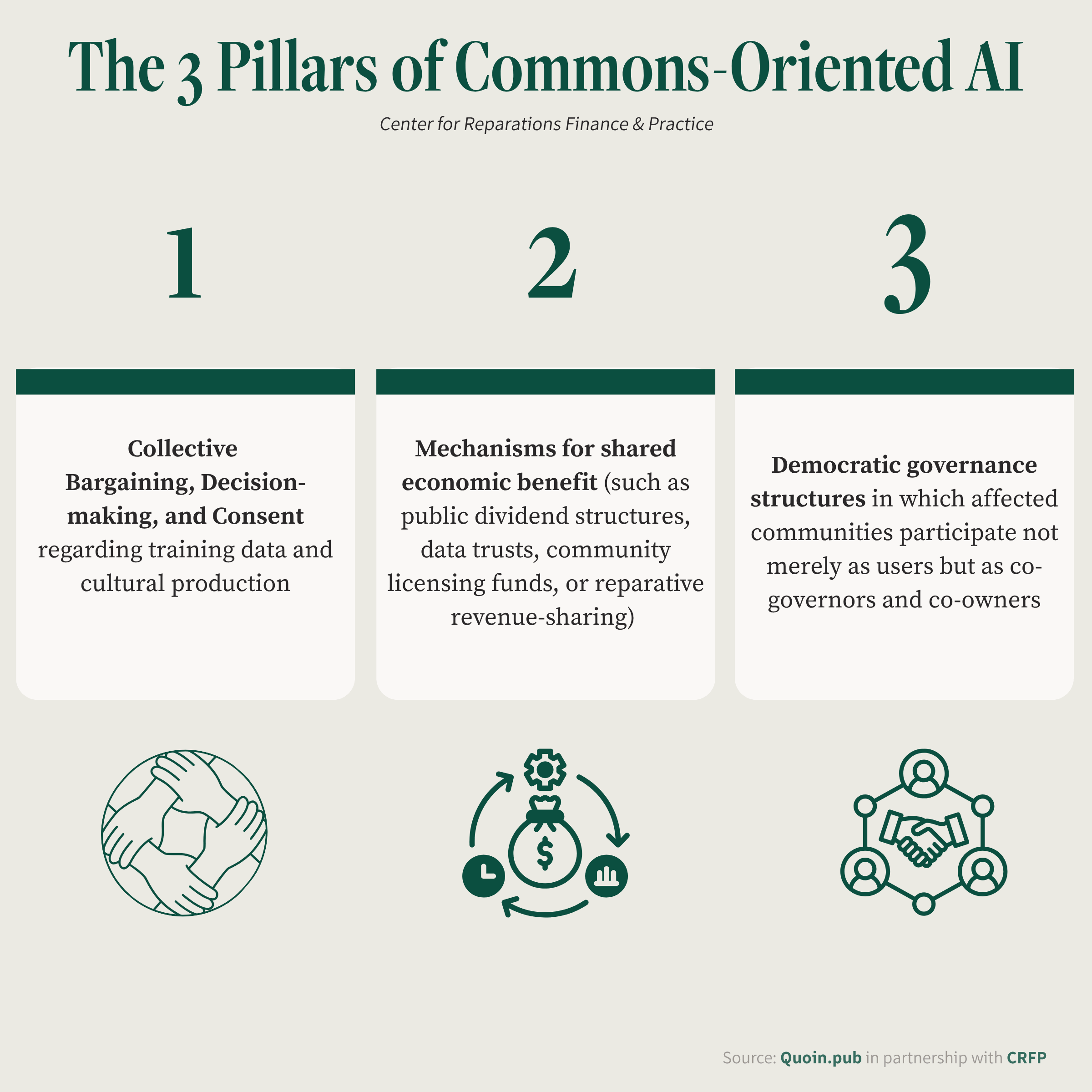
This strengthens the case for expanding governance in at least three directions which comprise the structural pillars of commons-oriented AI:
First, commons-oriented AI institutions would need mechanisms for collective bargaining, decision-making, and consent regarding training data and cultural production, rather than assuming that public availability is equivalent to legitimate appropriation.
Second, they would need mechanisms for shared economic benefit, such as public dividend structures, data trusts, community licensing funds, or reparative revenue-sharing arrangements for historically dispossessed groups.
Third, they would need democratic governance structures in which affected communities participate not merely as users but as co-governors and co-owners, with standing over how systems are trained, deployed, and monetized. Without these additional layers, the language of the commons risks becoming an ethical gloss on systems that remain extractive in practice.
Seen this way, the digital public goods model should be situated. It is a compelling example of how digital infrastructure can be designed around openness and stewardship, and it helps rebut the claim that proprietary enclosure is the only viable model for sustaining complex digital systems.
But precisely because it stops short of reparative ownership, it underscores the distance between a digital public good and a genuinely reparative AI commons. That gap is where legal innovation, institutional design, and political struggle become clear and necessary.
"Openness can become a reputational shield rather than a real transfer of power."
Imitation Risk: The risk of commons language without commons substance
A further limitation is the risk of imitation. As the language of digital public goods, openness, and public-interest technology gains legitimacy, firms and institutions may adopt commons rhetoric without changing the extractive political economy beneath it. The result is a familiar pattern: the language of shared benefit is used to legitimize systems that remain concentrated in ownership, opaque in governance, and unequal in the distribution of gains.
This risk is especially acute in AI, where companies can open selected parts of the stack—such as developer tools, model interfaces, or limited-weight releases—while retaining control over compute, data pipelines, licensing, and commercial surplus. In those conditions, openness can become a reputational shield rather than a real transfer of power. A platform may seem commons-oriented because it uses open language, offers partial transparency, or gestures toward community benefit, even as the key decisions about extraction, deployment, and monetization remain privately controlled.
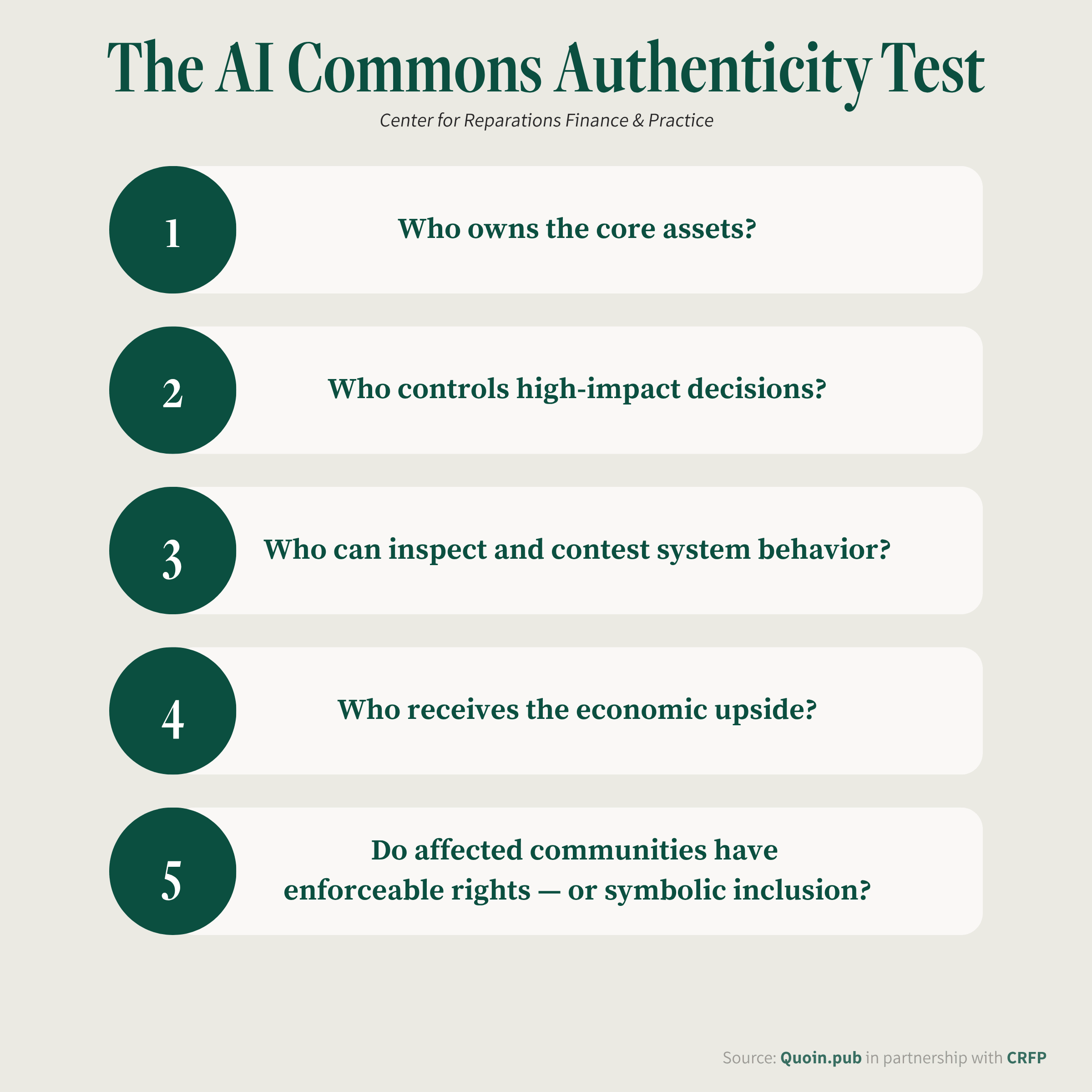
A credible AI commons framework therefore needs criteria that separate genuine commons governance from imitation. At a minimum, those criteria should ask who owns the core assets, who controls high-impact decisions, who can inspect and contest system behavior, who receives the economic upside, and whether affected communities have enforceable rights rather than symbolic inclusion. Without those tests, the language of the commons may be absorbed into the very systems it is meant to challenge.
Recommendations for Policy, Creative, and Economic Agendas
The task for leaders is not only to make AI safe but also to make it fair. In government, several steps are available now to lawmakers, agencies, and allied institutions. Congress should launch a focused initiative linking AI governance to political economy, racial justice, and reparative design, supported by hearings and analytical work from congressional support agencies. Federal privacy and AI legislation should include provisions for data dignity and collective data sovereignty, especially for high-impact systems.
In civil society, recent initiatives offer a framework for collective action. In 2025, the DPG ecosystem reported significant growth with more than 220 verified digital public goods and 50 DPGA members. The United States should engage with the DPGA and become a member of the Digital Public Goods Charter to advocate for reparative standards, racial justice metrics, and co-governance for marginalized communities.
Forward-thinking institutions, foundations, and lawmakers should develop an AI Commons Fund, establish revenue tools to capitalize it, and specify universal and reparative distribution mandates. Its administrators should require transparency about training data and deployment contexts for high-risk systems, enforce civil rights and consumer protection laws aggressively in AI contexts, and create stronger accountability for harmful uses in labor, housing, health, and public benefits.
In parallel, public and private investment should expand non-corporate AI capacity, including public research infrastructure, open and public-interest models, and grants to cooperative and community-led AI initiatives. These investments would help ensure that governance is not reduced to policing private firms but includes building public alternatives.
"A commons is not merely managed, but governed in relationship."
Conclusion
AI is often described as an unprecedented technological revolution. In one sense that is true. But its present political economy is painfully familiar: enclosure of a collectively produced resource, concentration of wealth and control, and the externalization of risk onto those with the least power. The deeper issue, then, is not only whether AI will be regulated safely, but whether it will be governed justly.
Treating AI as an intellectual commons offers a practical and principled way forward. It rethinks ownership, strengthens the public’s claim to AI’s benefits, and creates space for a reparative agenda that confronts the long histories of extraction underlying both technological modernity and today’s digital markets.
This framework also clarifies why openness alone is insufficient. Digital infrastructure can be structured around stewardship, mission constraints, and public benefit rather than pure shareholder extraction. But there are limits to infrastructure-level reform when questions of training data, collective consent, reparative ownership, and value-sharing remain unresolved.
For that reason, a genuine AI commons must go further. It must include democratic governance over systemically important AI, enforceable rights over data and cultural production, broad-based participation in economic gains, and reparative mechanisms for communities historically subjected to extraction. Without those elements, the language of the commons risks becoming aspirational rhetoric rather than institutional transformation.
The stakes are therefore larger than innovation policy alone. If AI is governed as a commons, its gains can be directed toward shared prosperity, democratic agency, and historical repair. If it is governed as an enclosed asset class, it may deepen the oldest patterns of dispossession under a new technical vocabulary. This framework offers one pathway towards that first vision.
An AI Commons recognizes the fundamental truth of the commons framework: that a commons is not merely managed, but governed in relationship. That is the shift required.
Enith Martin Williams is Founder & Executive Director of the Center for Reparations Finance and Practice, and Reparations Finance Lab.
References and Further Reading
Anthropic. "The Long-Term Benefit Trust." Anthropic, December 17, 2023. https://www.anthropic.com/news/the-long-term-benefit-trust.
Blackmon, Douglas A. Slavery by Another Name: The Re-Enslavement of Black Americans from the Civil War to World War II. New York: Anchor Books, 2008.
Darity, William A. Jr., and A. Kirsten Mullen. From Here to Equality: Reparations for Black Americans in the Twenty-First Century. Chapel Hill: University of North Carolina Press, 2020.
Distributed Artificial Intelligence Research Institute. "Research Philosophy." Accessed May 18, 2026. https://dair-institute.org/research-philosophy/
Du Bois, W. E. B. Black Reconstruction in America, 1860–1880. New York: The Free Press, 1998.
Fraser, Nancy, and Rahel Jaeggi. Capitalism: A Conversation in Critical Theory. Cambridge: Polity, 2018.
Ida B. Wells Just Data Lab. "About." Accessed May 18, 2026. https://www.thejustdatalab.com/about
Robinson, Cedric J. On Racial Capitalism, Black Internationalism, and Cultures of Resistance. Edited by H. L. T. Quan. London: Pluto Press, 2019.
Smith, Adam. An Inquiry into the Nature and Causes of the Wealth of Nations. Originally published 1776. Book I, Chapter 8.