Active Asset Management Works. Just Not the Kind You're Paying For: The case for direct indexing at mission-driven institutions
If your nonprofit or foundation pays an active investment manager, you’re almost certainly paying for underperformance.
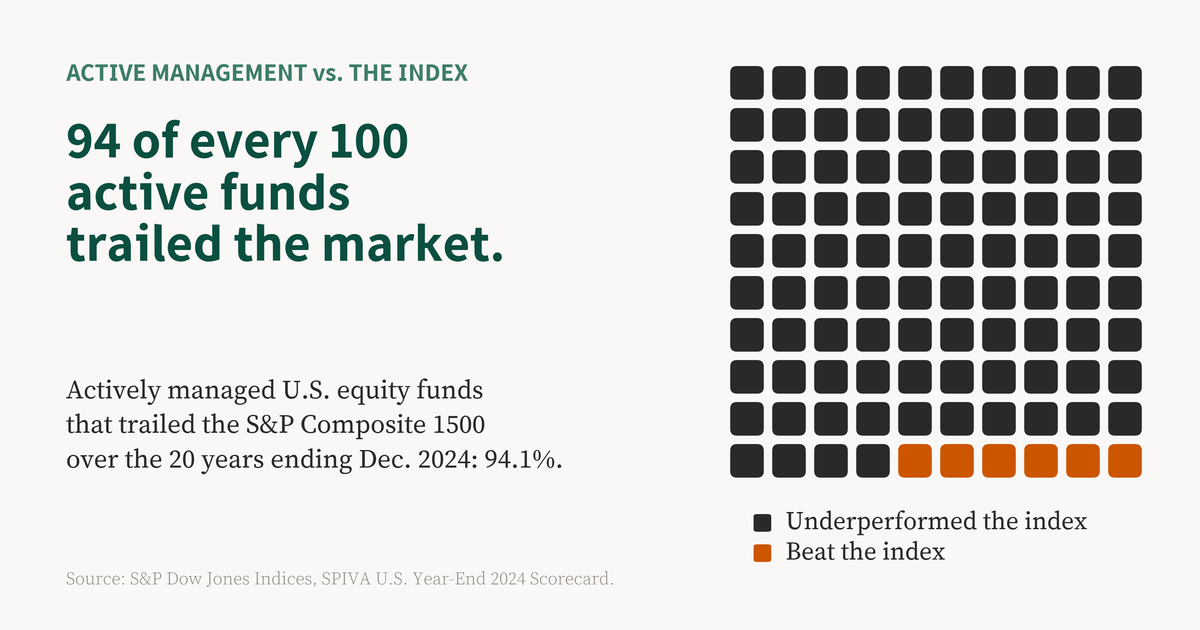
That’s what two decades of data show. The SPIVA Scorecard, published by S&P Dow Jones Indices and widely regarded as the definitive benchmark of active versus passive performance, has tracked this question since 2002. The results have been remarkably consistent. Over the 20-year period ending in 2024, 94% of actively managed domestic equity funds underperformed their benchmark index.[1] Over 15 years, more than 90% of large-cap active funds lagged the S&P 500.[2] And among funds that did outperform, the success almost never persisted: not a single top-quartile fund maintained that ranking over a subsequent four-year stretch.[3]
These are not edge cases. The typical institutional investor is paying management fees of 50 to 100 basis points annually for a strategy that, by the numbers, is more likely to trail a low-cost index fund than to beat one.
For mission-driven organizations, this raises an obvious question. What if the reason you use an actively managed fund is to invest in alignment with your values? If the financially rational move is to index, does that mean you’re stuck owning every company in the benchmark?
This is where most institutions get stuck. Indexing makes financial sense, but a standard S&P 500 index fund includes fossil fuel producers, weapons manufacturers, and predatory lenders. For an organization whose mission is rooted in social justice, environmental stewardship, or community well-being, owning those companies feels incongruent at best and untenable at worst.
So the institution stays with its active manager, often one who markets a values-aligned approach, and pays the premium that comes with it. The values feel addressed. But the underlying math hasn’t changed. The manager is still, statistically speaking, unlikely to outperform the index, and the fees still compound year after year. The institution has traded one problem for another: it solved the values question but reintroduced the performance question. Worse, a perception grows that you must sacrifice returns to invest in alignment with your values.
There’s a way out of this trap, and it doesn’t require choosing between returns and your principles.
Direct indexing means owning the individual stocks that make up an index rather than buying a single fund that holds all of them. For mission-driven organizations, this means you’re able to filter out or reduce exposure to the companies that conflict with your mission. Then, with the stocks that remain, you own them in a combination designed to closely perform like the full index. You're not just pulling names off a list and crossing your fingers. The remaining holdings are weighted so the portfolio tracks the benchmark's returns, just without the companies that conflict with your organization’s mission.
Nonprofits have an additional advantage here. To keep a direct index portfolio tracking closely, it benefits from regular rebalancing, sometimes as often as daily. For a taxable investor, that kind of trading activity creates capital gains that eats into performance. For a tax-exempt organization, it's a non-issue. Nonprofits can rebalance as aggressively as they need to without owing a dime in taxes on the trades, which means they can maintain a tighter match to the index than almost any other type of investor. Similarly, foundations are subject only to a small investment income tax, making this almost equally as attractive a tactic.
The question is whether this approach costs you anything. In 2025, it did not.
Consider the math. The S&P 500 returned 17.9% in 2025. A $1 million investment would have grown to roughly $1,179,000. Now imagine you'd built that same portfolio through direct indexing, screening out fossil fuel producers, military weapons manufacturers, tobacco companies, surveillance firms, and predatory lenders. Together, those exclusions affect somewhere in the range of 30 to 40 individual companies, representing roughly 5% to 6% of total index weight. The remaining holdings are reweighted to track the index as closely as possible. The result is a portfolio optimized to minimize what the industry calls tracking error: the gap between your portfolio's performance and the benchmark's.
On a $1 million portfolio in 2025, that gap would have been small. Using actual 2025 returns for the excluded companies and the remaining index, a values-screened direct index portfolio would have ended the year somewhere between $1,170,000 and $1,180,000. The difference from the full, unscreened S&P 500 is a few thousand dollars in either direction.
In any given year, the sectors you've screened out will fluctuate. In 2025, fossil fuels underperformed while defense stocks and tobacco producers outperformed. In 2026, that dynamic has flipped, with energy leading the index. That's not the point. You're not trying to outperform the index by removing these companies. You're trying to match it. The math shows you can do that while actively managing what your portfolio stands for.Compare that to the active management alternative. The typical actively managed large-cap fund had a better-than-even chance of returning less than 17.9% in 2025, and it charged a management fee on top of whatever it did return. The values-aligned direct index, by contrast, captured essentially the same return as the benchmark but while reflecting the institution's mission at the same time.
None of this means every direct indexing implementation is equal. The quality of the data behind the values screens matters. The rigor of the portfolio construction matters. The ongoing management matters. And honesty matters too. For most institutions, the goal of a perfectly clean portfolio isn’t always possible. But a meaningfully better one is. Some companies get removed entirely. Others get their weight reduced. A company like Amazon, for example, might be flagged for their labor practices but carry so much weight in the index that removing it entirely would make it impossible to track the benchmark's performance. So instead, you reduce your exposure as much as possible. The point is that even when a 500-company index can’t be made pristine, it can be made more intentional and less harmful to your core values.
Investing your values doesn't require paying for active management that's unlikely to deliver. Yet, that’s often the only option mission-driven institutions are offered: hand your portfolio to a manager who promises to align it with your mission and hope the returns hold up. The data says they usually don't. Direct indexing changes the equation. You get passive performance, active values, and lower fees. For a nonprofit or foundation, that's a win-win.
Mika Weinstein is CEO and George Guerrero is CIO of Just Futures, a community nonprofit-owned investment firm helping organizations and individuals invest in alignment with their values.
The views expressed are the authors' own and do not represent investment, tax, or legal advice, or a recommendation by Quoin. Performance figures or statistics are provided by Just Futures, which is solely responsible for the content of this article. Quoin does not endorse any investment strategy or firm, and Quoin and its members, owners, or staff may not share the opinions or views expressed. Readers should consult their own qualified advisors before making financial decisions.
The Standard & Poor's 500 (S&P 500) is an unmanaged group of securities considered to be representative of the stock market in general. It is a market value weighted index with each stock's weight in the index proportionate to its market value.
Indices are unmanaged and investors cannot invest directly in an index. Unless otherwise noted, performance of indices do not account for any fees, commissions or other expenses that would be incurred. Returns do not include reinvested dividends.
Rebalancing can entail transaction costs and tax consequences that should be considered when determining a rebalancing strategy.
Investing involves risks, including the loss of principal. Past performance is no guarantee of future results. The investment return and principal value of an investment will fluctuate so that an investor's shares, when redeemed, may be worth more or less than their original cost.
[1] S&P Dow Jones Indices, "SPIVA U.S. Year-End 2024 Scorecard." Over the 20-year period ending December 31, 2024, 94.1% of all actively managed domestic equity funds underperformed the S&P Composite 1500.
[2] S&P Dow Jones Indices, "SPIVA U.S. Mid-Year 2025 Scorecard." Over 15-year periods, more than 90% of U.S. large-cap active equity funds have consistently underperformed the S&P 500.
[3] S&P Dow Jones Indices, "U.S. Persistence Scorecard, Year-End 2024." Among top-quartile funds in all reported active domestic equity categories as of December 2020, not a single fund remained in the top quartile over the subsequent four years