"You Have Eyes That We Don't Have"
In the first episode of Quoin's flagship conversation series, Visions of the Future, Christina Herman shares a journey from scholarship to international activism to corporate engagement, highlighting the power of moral voice in global change.
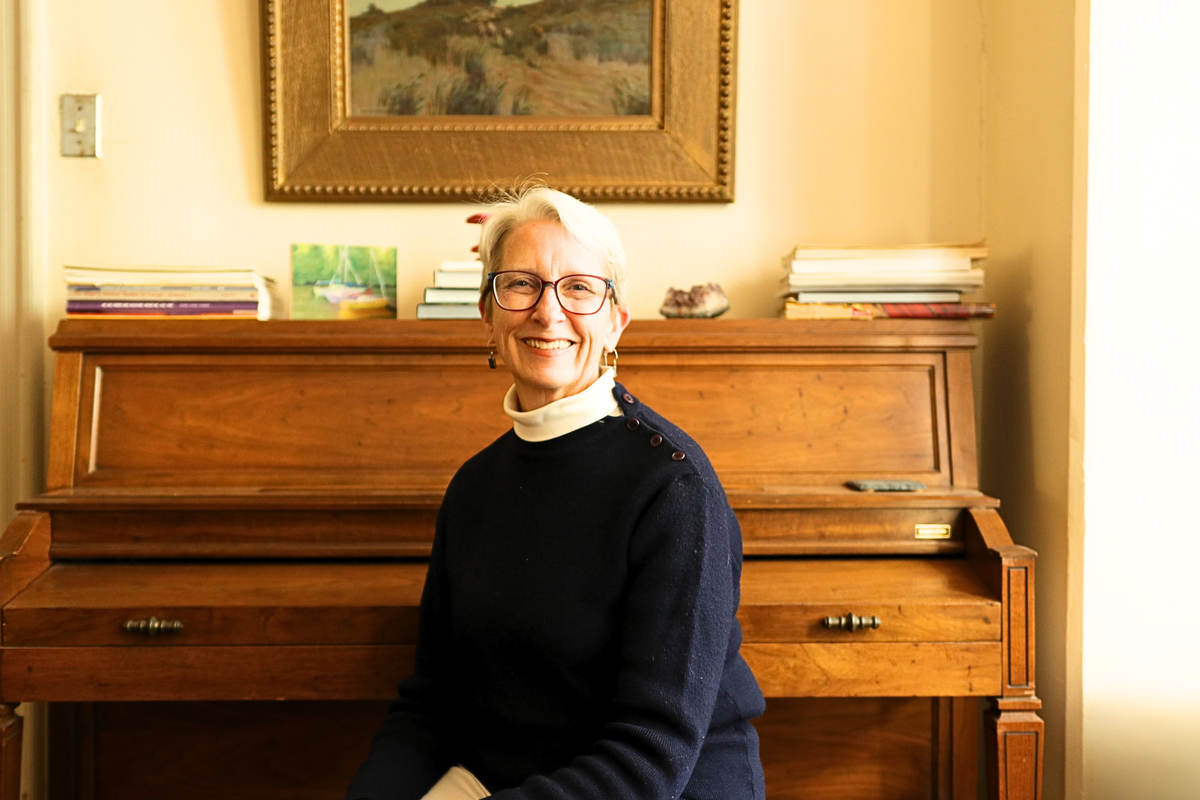

Christina Herman on fifty years of faith, shareholders, and speaking truth to power
Christina Herman's career took her from a village in Bucks County, Pennsylvania to Oxford, to the Philippines under martial law, and eventually to the rooms where church pension funds sit across the table from Coca-Cola and General Motors. For nearly two decades she did corporate engagement work through the Interfaith Center on Corporate Responsibility — first representing two Catholic investment funds, then coordinating ICCR's climate work across a network of 300 institutional investors.
I sat down with Christina for the latest edition of Visions of the Future. What follows are highlights from that conversation, edited for length and clarity. The full audio is worth your time and available above.
Grow where you're planted
You're retired now. If someone were to ask what it is that you actually did during your career, what would you tell them?
Oh my. Gosh — I think, the opportunity to continue to learn and to try to make a difference in the world. To add something good that wasn't there before.
How did you go about doing that? Because a lot of people are struggling with this idea of, how do I survive, how do I make something of my life — but at the same time, there's a lot that's not working in the world, and I want to do something about that.
There's that old phrase, grow where you're planted. That's often used in church circles, but I think it's really relevant here. You can do good and make a contribution in so many different ways, and everybody's so different — everybody finds a niche somewhere where they make a living and have particular work that is meaningful to them, that they enjoy and they're good at. And then within that, if you care about the impact of the economy, of society, of politics, of policy on other people, then there's a way for you to help shape that work and make that contribution. This idea of the common good is really important, and it can be a real North Star for people wherever they find themselves in their work.
Seventy letters
How did you find your way in? When you left university, what led you to this work?
I made a decision that I did not want to go to law school or business school. I did apply to law school and I got in, but I decided, no, I don't really want to do that. I was working in Boston at the time, and I was part of a little group that would meet once a month, and people would take turns giving a talk. This young woman who was at the law school talked about her experience working in a refugee camp in Somalia — and it was like a light bulb went off. I went up to her and said, how did you get there? She looked at me a little oddly, and she said, well, it's not difficult if you don't care about being paid.
So I went down to the careers library, did really thorough research, and sent off about seventy letters to different organizations. And I wrote my friends studying development economics who were out in the field: in your experience, who's doing really good work on the ground? The word came back — Oxfam, AFSC, and the Mennonite Central Committee. Mennonite Central Committee was looking for people who simply wanted to serve and had some skills to offer. So that's where I went.
Listen first
So here you were, in the Philippines. Did it turn out to be what you were expecting?
I couldn't have anticipated really what it was going to be like at all. There was so much to learn. I really spent three years learning and changing and becoming aware of some of my own assumptions about things. I think one of the most important things I learned was to listen to the lived experience of people affected by whatever it was — whether it was militarization or a plantation going in or deforestation. People knew what they needed for a prosperous life. They knew where the barriers were to their own economic and social well-being. And yet they weren't individually in a position to remove them. In some cases, they were stemming from Washington.
They said: we can organize ourselves and try to change things here in the Philippines, but there are some things that we just cannot change from here. We need you to be in your own country, trying to raise awareness and help change those policies — and the flow of money, frankly.
Owners at the table
What is corporate engagement? When you say "I do work in corporate engagement," what does that actually look like?
The process of corporate engagement is shareholders in a company reaching out with a set of concerns or questions for the companies in their portfolio. For our network, it was a way to bring moral and ethical concerns to the company — and you don't really separate that from risk factors. Really what it is, is just sitting down and talking with company representatives about a set of concerns that shareholders may have that they think are likely to affect the value of the company. It's this process of owners of the company engaging management to discuss certain issues that affect the well-being of the company and the larger society in which it's operating.
"You have eyes that we don't have"
What makes the companies care that you're engaging? Why do they listen to you — do they listen to you?
The companies actually found the engagements useful — and they told us this on a number of occasions. They said: you have eyes that we don't have. You bring an awareness of certain risk factors that we simply were not aware of before.
This became very evident when we started working on corporate water issues around 2007, 2008. Nobody was really talking that much about water use by corporations. We had a dialogue, which I led for five years, with Coca-Cola on their global water use — and water is their primary input. They were operating in some water-stressed areas of India, for instance — in Rajasthan, where they received almost all of the water through rainfall in about four or five days out of the year. We were concerned about what was going to happen long term, both to the watershed and to the local economy of that region, but also to the company's bottling plant. I mean, what happens when you run out of water? And that did in fact happen. They had to close that plant because there was not enough water to draw from.
It comes down to a license to operate. Those issues of how you're operating, where you're operating, and what your impact is on the local community — which ultimately can give you a license to operate, or revoke it — are very important for companies.
The first resolution
How did ICCR come to be? And how did it survive fifty-five years?
It started at the request of the South African bishops. Bishop Tutu, who became Archbishop later, was in this delegation of churchmen who came to the United States, met with the National Council of Churches, and asked for their help in trying to get rid of the apartheid regime. They knew that US corporations operating in South Africa were providing a flow of money to the government — through jobs and through their corporate taxes. So the ask was to put pressure on General Motors to leave South Africa. The shareholder resolution was filed by the Episcopal Church in 1971 — to a lot of negative feedback from other shareholders at the AGM when it was introduced. But that's what started the work.
And then the churches just started talking to each other — they were all in the same building, built for the churches by John Rockefeller in Manhattan. They met and said, well, maybe we should come together as a group. And so they formed ICCR.
Building the bicycle while riding it
Why should a young changemaker consider faith as a force for change?
Well, it's an organized force, for one thing, which is always useful. But I think more importantly, it's because these organizations are centered around concern for the common good, for ethics and morality. There's a caring that people have for each other that makes it a wonderful network to work in.
And the work was not always easy. Tudie Byron, who was one of the sisters who was very active in the network, said this work is always a bit like trying to build a bicycle while you're trying to ride it. And it was very true. When we were doing the work on corporate water, there were no corporate water tools out there — we helped create them because they were needed. Making your way through that, first of all, you have to do it as a group. And secondly, it really helps to be in a group where people have basic values of love and concern for one another, so you can keep going through what can be very challenging times.
The teachings of the church inform the way we would engage anybody — whether it was a policymaker in Washington or somebody in a company or somebody in a community. Everybody must be accorded respect, and listened to, with an effort to being open and trying to understand. Not being arrogant. A real dose of humility as you engage in all of this. And that is not done by preaching to, but rather by standing next to.
Don't hold back
When you look back and reflect today, is there anything you would have done differently — or anything you learned that you would hope to pass forward?
Talk to as many people as you can. Be open. The one thing I wish I'd done differently is I wish I'd had more courage. In that process of speaking truth to power, I was always so concerned — especially in the early days of my corporate engagement work — that I might not have it right. And then I discovered: everybody kind of feels that way. If you do your homework, and you do this with a real dose of humility and openness to learning — if you are convinced that something is wrong, or that there is an injustice being done, then don't hold back. Speak clearly. And work with others.
Have courage, I suppose.
This post has been updated to include written excerpts from the conversation.
Christina Herman is the former senior director for Climate Change and Environment at the Interfaith Center on Corporate Responsibility (ICCR).